Genome-wide copy number variant data for inflammatory bowel disease in a Caucasian population
Abstract
Genome-wide copy-number association studies offer new opportunities to identify the mechanisms underlying complex diseases, including chronic inflammatory, psychiatric disorders and others. We have used genotyping microarrays to analyse the copy-number variants (CNVs) from 243 Caucasian individuals with Inflammatory Bowel Disease (IBD). The CNV data was obtained by using multiple quality control measures and merging the results of three different CNV detection algorithms: PennCNV, iPattern, and QuantiSNP. The final dataset contains 4,402 CNVs detected by two or three algorithms independently with high confidence. This paper provides a detailed description of the data generation and quality control steps. For further interpretation of the data presented in this article, please see the research article entitled ‘Copy number variation-based gene set analysis reveals cytokine signalling pathways associated with psychiatric comorbidity in patients with inflammatory bowel disease’.
Available online: 7 May 2019
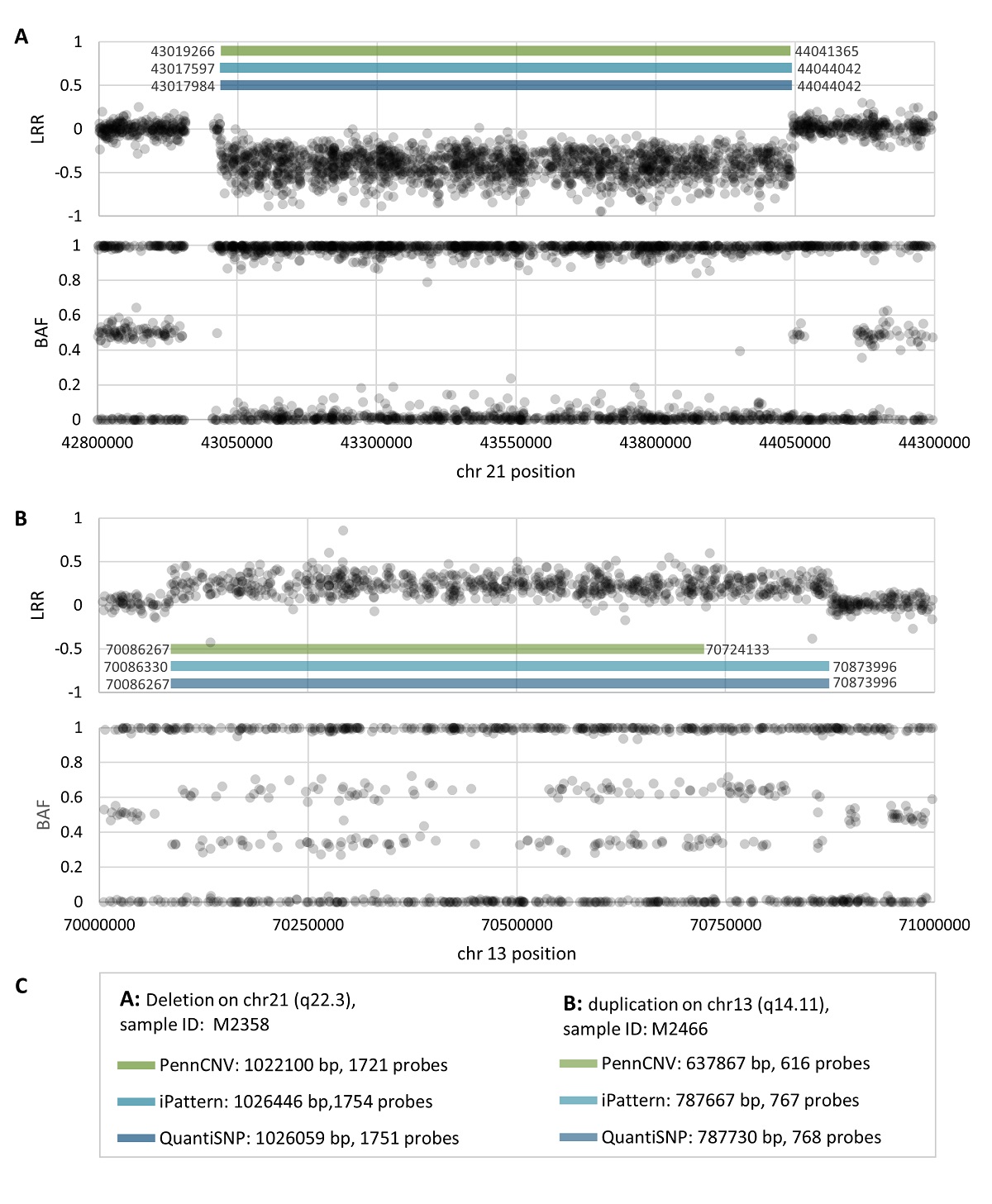
Examples of CNV deletion and duplication detected by all three algorithms. CNV length and number of probes for each algorithm were provided. Start and end probe positions for each algorithm were presented on the corresponding bars. Outer start and end positions were used as start and end positions of the stringent CNV. A: An example of deletion found in chr21q22.3; B: An example of duplication found in chr13q14.11; C: the start and end positions of the CNV detected by each of the algorithms and the corresponding number of probes. LRR: Log R ratio; BAF: B allele frequency. See details in the publication.